Tourisme Leros 2026
2026 marks a turning point for Greece. After breaking post-pandemic visitor records, the country is increasingly seeking to diversify its tourism offer in order to counter overtourism on certain islands, such as Santorini and Mykonos. However, the season in Leros is expected to be very different.
Tourism professionals have been campaigning for years to extend the season and encourage mass tourism, which would be more profitable. However, no action has been taken to develop tourism on the island. Leros is not at all suited to mass tourism: the beaches are small, and the water and electricity infrastructure fails whenever there are slightly more visitors on the island.
The season used to begin around Easter, generally in April, and continue until the end of September. It now starts at the end of July and ends in mid-September.
The question is therefore: is it still worth coming to Leros on holiday with all these changes?
The Western Bourgeois-Bohemian Clientele Is Moving On
For visitors coming from Western Europe, Leros has to be earned. It is difficult to make the journey in a single day, with only one flight from Athens in the morning at 7:30 a.m. Sometimes there is a second flight in the evening at 6:30 p.m., but the aircraft has only 20 seats, making it difficult to find a place.
The Greek islands benefited greatly from the bourgeois-bohemian trend of the 1980s and 1990s, when spending a holiday in Greece was considered very fashionable. Today, visitors are more concentrated in the Cyclades, which are much quicker to reach from European capitals. The atmosphere there has become similar to Saint-Tropez.
Many island lovers invested in property in Leros. Some are now exhausted by the difficulties involved in carrying out even small repairs or maintenance work, faced with broken promises, unreliable appointments and excessively high prices.
For many years, Leros was fortunate to attract Western tourists, including many Italian and French bourgeois-bohemian visitors who admired the Greek lifestyle. Many of them bought houses on the island. However, spending a family holiday in Leros is difficult because the island offers virtually no activities for tourists. Young people no longer come to Leros for their holidays. In 2026, most of them did not come to the island, due to exorbitant prices, a lack of enthusiasm and the preferential treatment given to Turkish visitors.
The Decisive Turkish Shift in Leros Tourism
By contrast, Leros is increasingly focusing on attracting Turkish visitors, mainly from the nearby coastal region, who come for short stays, with drinking often presented as their main activity. As Muslims, they are generally less interested in Leros’s tourist monuments, which mainly consist of chapels.
A number of Turkish investors have established themselves on the island in order to develop tourism facilities. One of the perceived advantages of the Turkish clientele is that they generally prefer to leave little trace, while payments are often made in cash. As a result, this clientele receives considerable preferential treatment.
Tourism in Leros is undergoing a profound transformation.
The Special Visa and the New Turkish Tourism Flow
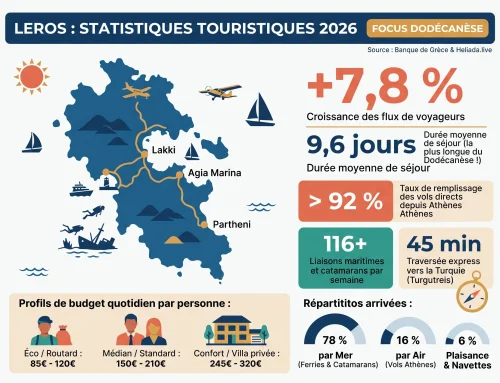
For the past three years, Greek Prime Minister Kyriakos Mitsotakis has granted Turkish citizens access to a tourist visa limited to three days. Turkish ferry companies quickly seized the opportunity created by this new tourism offer, unlike the Greek companies. Since last year, two catamarans have therefore been arriving in Leros every morning and leaving again in the evening.
After disembarking from the catamaran, passengers should expect approximately three hours for customs procedures. The waiting area is in full sunlight, and the three-day visa costs €60, while the journey itself costs €80. It seems that, possibly in exchange for additional payment, there may be a way to extend the duration of the tourist visa. Time is money!
Prices in Greece appear to be much more attractive than those in the seaside resort of Bodrum, particularly in restaurants and bars. Alcohol is around six times cheaper, although Greek restaurant owners have obviously raised their prices in response to this new clientele, whose major advantage is that they pay in cash.
Hotels in Leros ask guests to check out very early in the morning, around 9 or 10 a.m., in order to accommodate the new arrivals. However, on the final day, since the catamaran leaves at around 4:30 or 5 p.m., Turkish tourists are left to themselves in the bars of Agia Marina because there is no luggage-storage service available to help them enjoy the day. As a result, they spend the day waiting in the bars of Agia Marina, where prices have also risen rapidly.
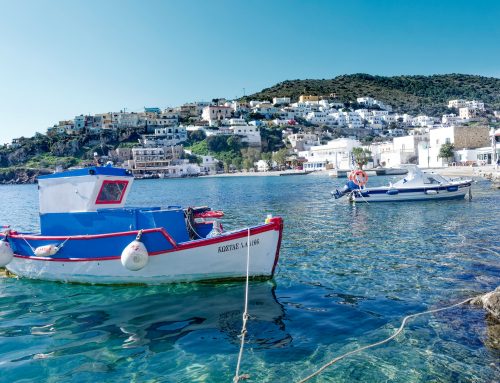
Tourism from the Turkish community is becoming organised through the exchange of recommendations on social media. Stays take place almost exclusively in Pandeli, and visitors hardly leave the area during their three-day visit. The small fishing port has been almost taken over, much to the delight of Pandeli’s shopkeepers.
Only the constant flow of taxis in the early evening transports customers from the boats anchored in the bay to Mylos Taverna or Harris Bar. Brand-new vans are now helping to make these journeys more efficient. Is this the beginning of a new organisation?
Will Leros become known as “Leros-Ta” in the near future? In view of the tidal wave of Turkish visitors and their appropriation of certain places on the island, such as Pandeli, the island’s tourism economy is already dependent on this sudden influx. This clientele may soon impose its preferences, prices and habits, just as Turkish influencers, who are particularly active on Instagram and TikTok, make recommendations for local establishments. With no strategy from the local businesses, these influencers have been able to act as they pleased.
This situation is also likely to become more pronounced in the future with the Turkish catamaran operator, which will impose its own conditions. This is what happens when hesitation continues for too long and when an important sector for the island is not properly developed.
However, there is one warning: Western visitors may not return. Leros will have to find a way to operate with its Turkish neighbours. The balance is fragile and dangerous, and the slightest event could change everything.

Turkish Tourism Investments Are Very Significant
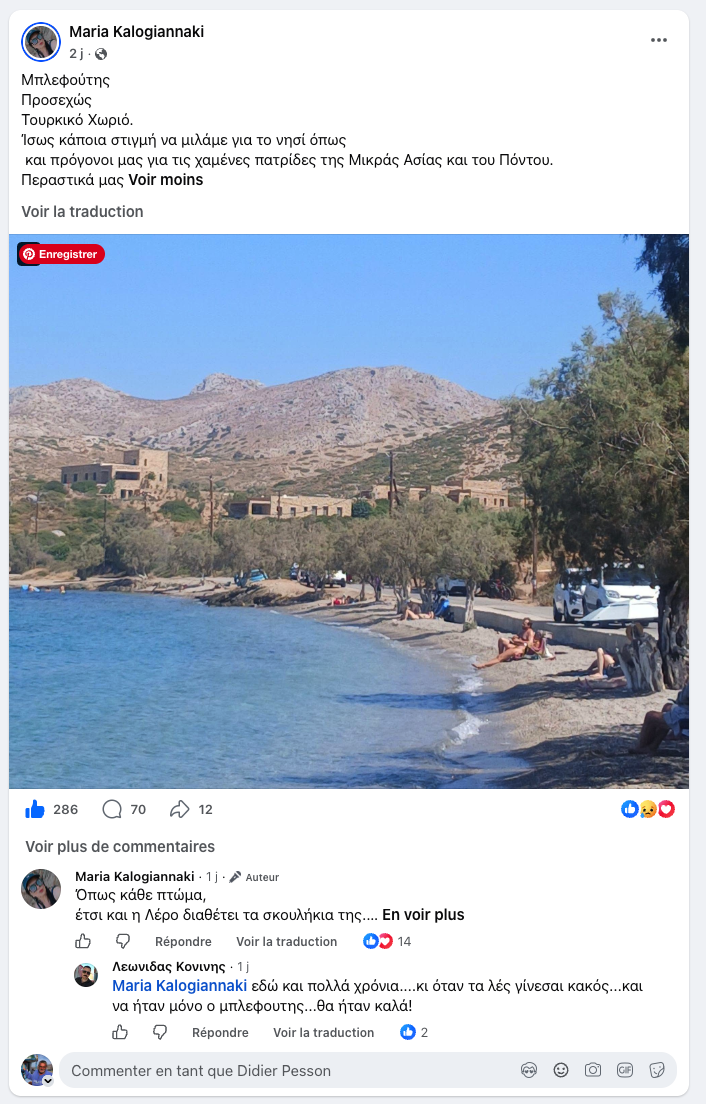
Turkish investors, operating through offshore companies, have purchased numerous plots of land in Leros, including some very large properties. This could represent a genuine Trojan horse, with construction projects that began three years ago to develop tourist complexes featuring restaurants and bungalows.
It feels as though everything is being organised to accommodate a very large flow of tourists in these villages from next year onward, particularly in Blefoutis. This development is expected to increase significantly, even though the island’s water and electricity infrastructure is already completely overwhelmed during the summer.
Introducing mass tourism to Leros does not appear to be the best solution for the island and is causing deep concern among the local population.
There is no doubt that Turkish influencers have taken control of much of the communication and promotion. Very active influencers are promoting establishments in Leros across social media.
Unfortunately, there is also a strong impression that this new situation is completely beyond the municipality’s control.
Leros Tourist Attractions
Diving Tourism
In 2026, Leros’s main attraction lies in its underwater wreck heritage, which is unique in the Mediterranean. However, this does not seem to attract many tourists, since the diving club moved to another island for the summer of 2026 due to the low number of bookings.
Underwater natural and historical park: The island was the scene of the famous Battle of Leros in 1943 during the Second World War. The seabed is home to numerous aircraft wrecks, including German Junkers bombers and British fighter planes, as well as warships such as the destroyer HMS Intrepid and the Queen Olga.
In addition, the seabed has been damaged by fishermen and is completely uninteresting, even for snorkelling.
Development: Local and national authorities have recently relaxed the laws governing diving around historic wrecks in Greece. Leros has actively promoted the creation of themed diving routes, attracting divers from around the world, generally environmentally conscious visitors with significant spending power.
Historical and Architectural Tourism in Leros
Leros has a distinctive feature that sets it apart from traditional Cycladic architecture, with its famous white-and-blue houses:
Lakki, formerly Portolago: This town is one of the rare and largest examples of Italian Rationalist architecture, combining Art Deco and Bauhaus influences, outside Italy. Built during the Italian occupation of the Dodecanese under Mussolini, it now attracts architecture students, historians and art enthusiasts.
The fortresses: The Castle of Panteli, also known as Kastro, and the former Italian wartime tunnels, now converted into museums such as the Merikia War Tunnel, broaden the range of activities available beyond simple days at the beach.
Leros Tourism and Gastronomy
Culinary Tourism as a Major Driver of the Local Economy
Culinary tourism is a major driver of the local economy in 2026. Leros’s gastronomy benefits from unique influences linked to its past as a commercial crossroads and to the Italian period.
Exclusive products: Leros promotes local products such as gavafes, a unique tropical fruit that grows only on this Greek island, its renowned thyme honey, mizithra, a cheese preserved in red-wine must, Kolios Pastos, salted mackerel, and a hybrid Italian-Greek cuisine.
2026 trends: Tourists are looking for authentic family-run tavernas offering a genuine “farm-to-table” or “sea-to-table” experience rather than large international restaurants, thereby supporting the island’s circular economy.
Following the success of the MYLOS restaurant, all the tavernas are turning into gourmet establishments. However, there is a strong chance that you will find the same dishes on your plate as those you would cook at home.
It is not certain, however, that this type of tourism will be sufficient to attract visitors to stay on the island.
Challenges and Issues Facing Leros Tourism in 2026
Despite these assets, the analysis of tourism in Leros for 2026 highlights several challenges:
- Managing seasonality: Like many Greek islands, Leros needs to extend its tourist season, which is currently concentrated from June to mid-September, by relying on its historical and diving attractions, which can be enjoyed in spring and autumn.
- Maintaining infrastructure: The island must preserve a functional transport network and modernise waste management and freshwater systems, which are crucial issues for the small islands of the Aegean Sea.
- Preserving its identity: The major challenge in 2026 is to develop economically without attracting developers of large hotel complexes or resorts, which could undermine the island’s unique boutique character and natural, unspoiled atmosphere.
In conclusion, in 2026, Leros does not compete with Rhodes or Kos in terms of visitor numbers. Its success depends on qualitative growth. The island has become the archetype of an alternative destination for mature, educated European travellers seeking ecotourism and history.
UN COMMUNICATION TOURISME 2026 LEROS BIZZARRE
Unlike other Greek islands, Leros has no coordinated social media strategy for promoting tourism on the island. You choose to come to the island rather than being actively invited. Then you leave exactly as you arrived, and nobody ever asks whether you were satisfied, or satisfied with what. “Move along, there is nothing to see!”
As a result, everyone produces their own small promotional video independently, generally focusing on the contents of a plate. The notion of user experience is never mentioned. You often see tavernas with empty chairs, while other Greek islands show visitors that they will enjoy a unique experience, including breaking plates. What a contrast!
The quality of many videos actually works against the island’s image. The messages are sales invitations, but without any real offer and without using humour or disruptive communication techniques.
In 2024 and 2025, many residents were delighted by the arrival of a Turkish cruise ship, and especially by the economic benefits it generated. Yet nothing was done to make the stopover more attractive. After visiting Kos and Rhodes, it was difficult to persuade passengers to stop in Leros. A survey of the cruise passengers eventually encouraged the company to cancel the stopover. No lessons were learned from this experience.
And there is never any call to action!
Leros Tourism 2026: The Great Inflation
Leros Tourism and Gastronomy
From May onwards, all restaurants increased their prices by more than 20%, just as they did last year. The increase is even more striking because nothing else has changed: the same terrace, the same plate, the same recipe. The comparison is therefore easy to make. In three years, a Horiatiki salad has risen from €6 to €10 for exactly the same dish, and possibly even a smaller portion.
The economic model of generating the entire annual turnover in 110 days has become completely outdated since the introduction of electronic tax reporting. Prices continue to rise, even though the cost of the service provided has long since been exceeded. The ingredients used in Greek dishes are not particularly expensive, and neither is their preparation.
And what about seafood? One might begin to doubt that we are actually on an island with numerous fishermen. Of course, fishermen and restaurant owners blame each other for this inflation.
The entire tax burden has been passed on to consumers, resulting in outrageous prices that very few local residents will be willing to pay once the tourist season is over.
To make matters worse, there was another special price increase in August. Since the season started very late, the businesses had to make up the difference somehow. Another aggravating factor was the large number of Instagram posts published by Turkish influencers comparing prices in Leros with those in Bodrum.
The result was a sharp rise in prices in Agia Marina, particularly for Turkish visitors who spend hours waiting for their boats to return.
A great memory of Leros, and have a safe journey home!
The Course of the 2026 Season
- Many migrant workers arrived to work in local businesses and prepare for the opening of the season in April.
- Work began at the start of May, with businesses opening around that time for Mother’s Day and May Day.
- The first Turkish gulets arrived on May 10, including the Kaya Güner III and Kaya Güner V.
- The great silence during the Easter holidays.
- Pleasure-boat owners arrived in mid-April, but quickly left the island and organised transfers among themselves.
- The regatta involving 20 sailing boats took place on May 7 and 8. It was organised by Fotis from the Fish Taverna in Gourna, supposedly to bring 100 people to the island.
- Leros is eligible for reimbursement under the Greek government’s social tourism programme.
- The war in Iran broke out, creating uncertainty about future airfares as the price of jet fuel continued to rise.
- Hantavirus appeared in mid-May 2026.
- The first Turkish catamaran arrived on May 14, 2026, and continued operating until October 18.
GOOD TIPS 2026 LEROS
Changes That Are Transforming Tourism in Leros
Since last year, two trends have been changing the nature of tourism in Leros, making peaceful holidays increasingly difficult.
Sun loungers are now usually charged for, and the prices are close to those found in Mykonos. Restaurants have become more focused on high-volume dining, arranged like cafeterias with an astonishing number of tables. This has taken away the intimacy of the traditional taverna.
Reservations are also necessary, which further undermines the charm of a relaxed and carefree holiday. The prize goes to Archangelos Taverna, once a wonderful place offering a truly memorable experience. It now operates only in the evening, from 6:00 p.m. to 9:00 p.m., and by reservation only.
We can only recommend Fotis’s Taverna on Gourna Beach. You will be welcomed with a smile, which is becoming increasingly rare, and you can enjoy traditional home cooking in the true spirit of a Greek taverna, which is also becoming rare.
A small piece of watermelon, just as in the good old days of filoxenia, delighted us before a short nap on the sun loungers generously provided by the taverna, or in the cool shade of the tamarisk trees.
The 2026 Tourist Season in Leros and the Greek Islands
Several surveys are currently examining European tourism trends for 2026. They are already providing important insights.
The first factor concerns SECURITY around the world. This climate is encouraging people to avoid long-distance travel. They now prefer to spend their holidays closer to home.
The second factor is FINANCIAL. Airfares are becoming more expensive every week, so travellers want to avoid spending all their money on a holiday. Inflation is also reducing restaurant budgets. Restaurant owners on the Greek islands are increasing their prices by 20%. This rise is likely to discourage many customers. Local taxes partly explain this decision. However, summer 2025 prices already seemed very high for such simple dishes.
The third factor is relatively new. Many people are avoiding Greece because of the intense heat. The heatwaves of 2024 and 2025 left a strong impression. Today, tourists are increasingly looking for active holidays. Simply relaxing on the beach attracts fewer visitors. The lack of leisure activities also discourages long-distance travel, especially among younger people.
In February 2026, Prime Minister Kyriakos Mitsotakis spoke publicly. According to him, the 2026 season would be less successful than in previous years. Yet the preceding years had broken all records.
Tourism sustains the island’s economy. Yet the municipality is doing nothing to attract visitors. The 2026 tourist season in Leros is therefore expected to be very quiet. Travellers will see no new developments.
The island is now turning away from Western European visitors, even though these tourists contributed to its success for many years. Today, the island is mainly targeting Turkish tourists. Four catamarans will arrive from Turkey every day this year. The large Turkish cruise ship no longer stops here.
Catamaran passengers stay for only a short time, usually no more than two or three days. They spend little because our cuisines are similar. Greek culture and the island’s chapels do not interest them. This clientele is very different from the wealthy yacht owners in Pandeli.
This trend is likely to grow further in the coming years. In the past, Turkish citizens were unable to purchase property here. Today, they are investing heavily in real estate in Leros. They buy homes to rent them out on Airbnb. Turkish investors now own approximately 15% of the island’s habitable land. This movement is accelerating rapidly.
History therefore seems to be reshaping the island’s destiny.